
Charles Joguet's 'Home Vineyards'
No.31 | Vineyard in Focus
While the majority of the viticultural activity in Chinon takes place on the north side of the Vienne River, if we turn our attention to the appellation’s rive gauche and head to the sleepy village of Sazilly, we will find two vineyards of great renown and the legendary domaine that owns them - Clos de la Dioterie and Les Varennes du Grand Clos of Domaine Charles Joguet.
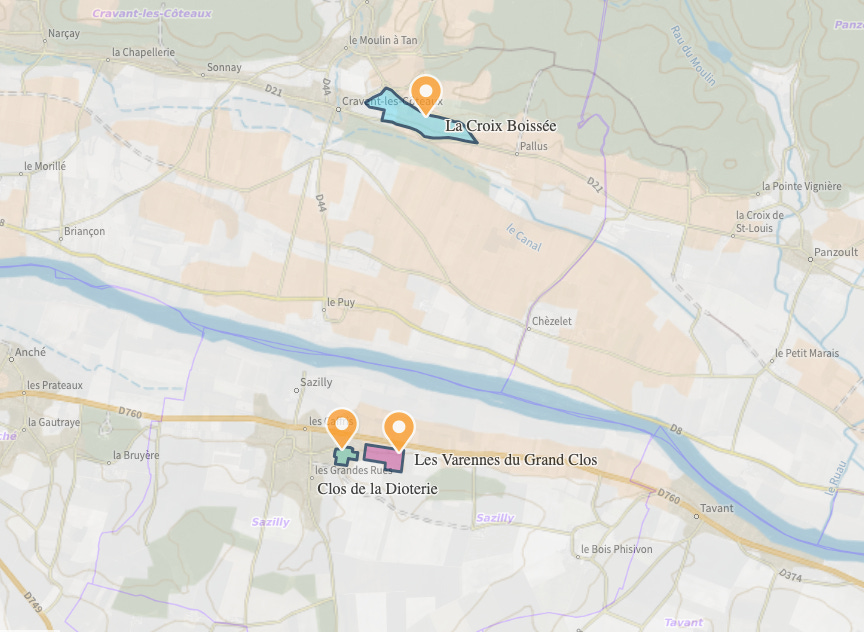
The commune of Sazilly is on the southern banks of the Vienne directly across from the eastern part Cravant-les-Côteaux and western Panzoult, and the commune is bordered to the west by Anché and to the east by Tavant. The viticultural activity in the commune takes place over a narrow area of land flanking either side of the D760 stretching the length of the commune (about 4.5km). The vineyards here are generally flat, or with a very gentle north-facing slope, and for the most part the commune is dominated by ancient alluvial soils (similar to those on the opposite side of the river) that have a sandy or clayey-sand texture with varying amounts of gravels in the topsoil and subsoil, a type of terroir that is sometimes referred to locally as varennes, depending on where you are.
In the western part of Sazilly, where we find a few more pronounced slopes and the influence of the Turonian tuffeau chalk, it is not the Upper Turonian yellow tuffeau or the Middle Turonian white tuffeau here, rather the Lower Turonian tuffeau (Turonien inférieur). This tuffeau is an argillaceous chalk, which has a slightly higher clay content in it, and is locally classified as “white marl chalk” (craie marneuse blanche) in terms of the terroir unit. What is particularly interesting (at least for a nerd like me) is this is one of the few areas not only in Chinon but in all of the Cabernet Franc appellations in the Loire where we find a notable impact of the Lower Turonian tuffeau chalk, which is normally found as the underlying bedrock on the alluvial terraces several meters well below the surface in Chinon, Bourgueil and St-Nicolas-de-Bourgueil. (How this comes through in the finished wines remains to be seen, but it is something I will try to better understand as my research on the vineyards and terroirs of the Loire continues.)


It is on these slopes in western Sazilly where we find Domaine Charles Joguet, and Clos de la Dioterie and Les Varennes du Grand Clos, which are often referred to as the domaine’s “home vineyards” as they are just adjacent to one other around the periphery of the domaine.
Clos de la Dioterie (the green shaded area on the map above) has been part of the Joguet family’s holdings since the Renaissance, and has been identified as a noteworthy site since the Middle Ages. Vines have been planted here since the 18th century, and today some of the oldest vines here are upwards to 90 years of age. The vineyard is about 2.2 hectares in size and sits on a moderate north-facing slope, with the lower portion of the vineyard on a gentler slope, while the upper portion sits on a more narrow, dramatic slope. The vineyard as whole rises to a height of about 49m above sea level (you can almost see La Croix Boissée across the Vienne from the top of the slope). In terms of soils, there is a shallow topsoil with a higher percentage of clay that is moderately stony, followed by the Lower Turonian white marl chalk bedrock. The combination of the north-facing exposure and the clay-dominated soils makes this a cooler, later site, often the last to be harvested of the domaine’s vineyards.


Les Varennes du Grand Clos is a 4.5 hectare vineyard (the purple shaded area in the map above) and is essentially an extension of Clos de la Dioterie, just a few hundred meters east. It was purchased by Charles Joguet in 1962, and was partially replanted in 1962 and 1976, with the remaining block likely planted in the 1920s. Similarly to Clos de la Dioterie, the vineyard has a north-facing exposure, though the slope is a bit less pronounced, and once again we find the influence of the Lower Turonian tuffeau chalk, most notably in the upper third of the vineyard. The topsoil varies with more clayey-sand at the top of the slope, and deeper alluvial sandy-gravels towards the bottom of the slope (perhaps giving this lieu-dit its name - suggesting the alluvions (varennes) of the “grand clos” referring to La Dioterie).
It is worth noting that thanks to this area of deeper sands towards the bottom of the slope, there was once a small parcel of ungrafted Cabernet Franc planted at Les Varennes du Grand Clos. The parcel was first planted in 1982, and sections were subsequently replanted a number of times through the 90s because the vines succumbed to phylloxera. During this time, in the best vintages, the domaine would make a separate bottling of from this parcel called Les Varennes du Grand Clos ‘Franc de Pied.’ Despite the domaine’s best efforts to keep this parcel alive, the louse eventually won out and these vines were grubbed up in late 2007, and the last vintage of this ‘Franc de Pied’ bottling was 2007.
In the Glass
In recent years I have had the opportunity to taste a few examples from these two vineyards, though not as many as needed to be able to properly articulate the nuances between these two cuvées. That said, these cuvées are unquestionably at the top of the Charles Joguet range, with Clos de la Dioterie consistently deemed the most age-worthy, harmonious and complete, on par with or followed closely by Clos du Chêne Vert (depending on who you ask… and probably the vintage), followed by Les Varennes du Grand Clos.
In my limited experience with these three wines, Clos de la Dioterie and Les Varennes du Grand Clos show notable similarities in the glass, both tending to lead with darker, more brambly fruit, which is complemented by notes of graphite and sweet spices. Clos de la Dioterie tends to be more broad-shouldered with firm, chalky tannins that can be a bit chewy in their youth, with great balance, composure and persistence through the middle palate and finish. Les Varennes du Grand Clos is a bit more perfumed and aromatic, with fine-grained, seamless tannins, a certain accessibility to the fruit, and a touch of added lift, spice and finesse towards the finish. Clos du Chêne Vert typically shows a mix of red and darker fruit, and pleasant herbal and floral undertones, with a well-chiselled palate featuring, tightly-woven, velvety tannins, great clarity of fruit in the mid-palate, and impressive focus and length through the finish.
In the age of climate change, it will be interesting to see how these three vineyards will fare and how the cuvées may evolve in the future. Clos du Chêne Vert is certainly a warmer site, with a southwestern-facing exposure and harvested upwards to 10 days before Clos de la Dioterie, while both Clos de la Dioterie and Les Varennes du Grand Clos are afforded a more gradual ripening period thanks in part to their northern exposures. Regardless of what the future holds, all three of these cuvées are cellar-worthy examples of Loire Valley Cabernet Franc that will age gracefully over decades (easily 20+ years) and gain complexity with time in the bottle.


Great essay. That 1990 Clos de la Dioterie brings back great memories. It’s the first wine I ever bought a whole case of. I drank the last of it several years ago. Loved that wine.
The context is fantastic! It’ll all make sense to me one day - thanks to you :)