


Despite the wealth of acclaimed, highly valued vineyard sites across the Cabernet Franc appellations of the Loire, the parcellaire approach remains rare across the Loire’s Cabernet Franc appellations, though a handful of producers have long championed it — Clos Rougeard, Thierry Germain, and Romain Guiberteau in Saumur-Champigny and Saumur; Yannick Amirault, the Caslot family of Domaine de la Chevalerie, and Pierre Gauthier of Domaine du Bel Air in Bourgueil and St-Nicolas-de-Bourgueil. And in Chinon, domaines like Charles Joguet, Olga Raffault and Bernard Baudry were among the first in the appellation to showcase that Cabernet Franc could be a mirror for terroir by making site-specific expressions from vineyards like Clos de la Dioterie, Les Picasses, and La Croix Boissée.
The Chinon appellation, in particular, with its rich history thanks to the village’s connectedness to French royalty and nobility, the Catholic Church, as well as being the home of French renaissance writer and scholar François Rabelais, has one of the most important collections of historical vineyards of all red wine appellations in the central Loire. The practice of naming lieux-dits on wine labels can be traced back to the early 20th century and lieux-dits were mentioned on restaurant menus by the late 19th century. And by the early 1940s some of the region’s lieux-dits had even been given “premier cru” status by the Annuaire des Marques et Appellations d’Origine des Vins, Eaux-de-Vie et Spiritueux de France, one of the premier wine guides of the time.
The advantages of the parcellaire approach have been modelled in other French regions, like Burgundy and Alsace. And by connecting the wine to a specific vineyard, it allows the vigneron to tell a compelling story about terroir and sense of place, and it can also serve to premiumize the wine. In Chinon, however, up until recently, promoting these vineyards was left to individual vignerons working alone, each telling their own story about their own parcels. Today, the entire appellation has begun to tell that story together.
Recognition, Not Classification
In 2014, the Chinon Syndicat and its producers drafted an ambitious, long-term project to promote this rich vineyard heritage, while also understanding the complexities and limitations of creating a formal classification within the framework of the INAO. The project, the first of its kind among the Loire Cabernet Franc appellations, would allow vignerons to work as a collective to properly recognize the region’s lieux-dits without the need for an official hierarchy or technical criteria.
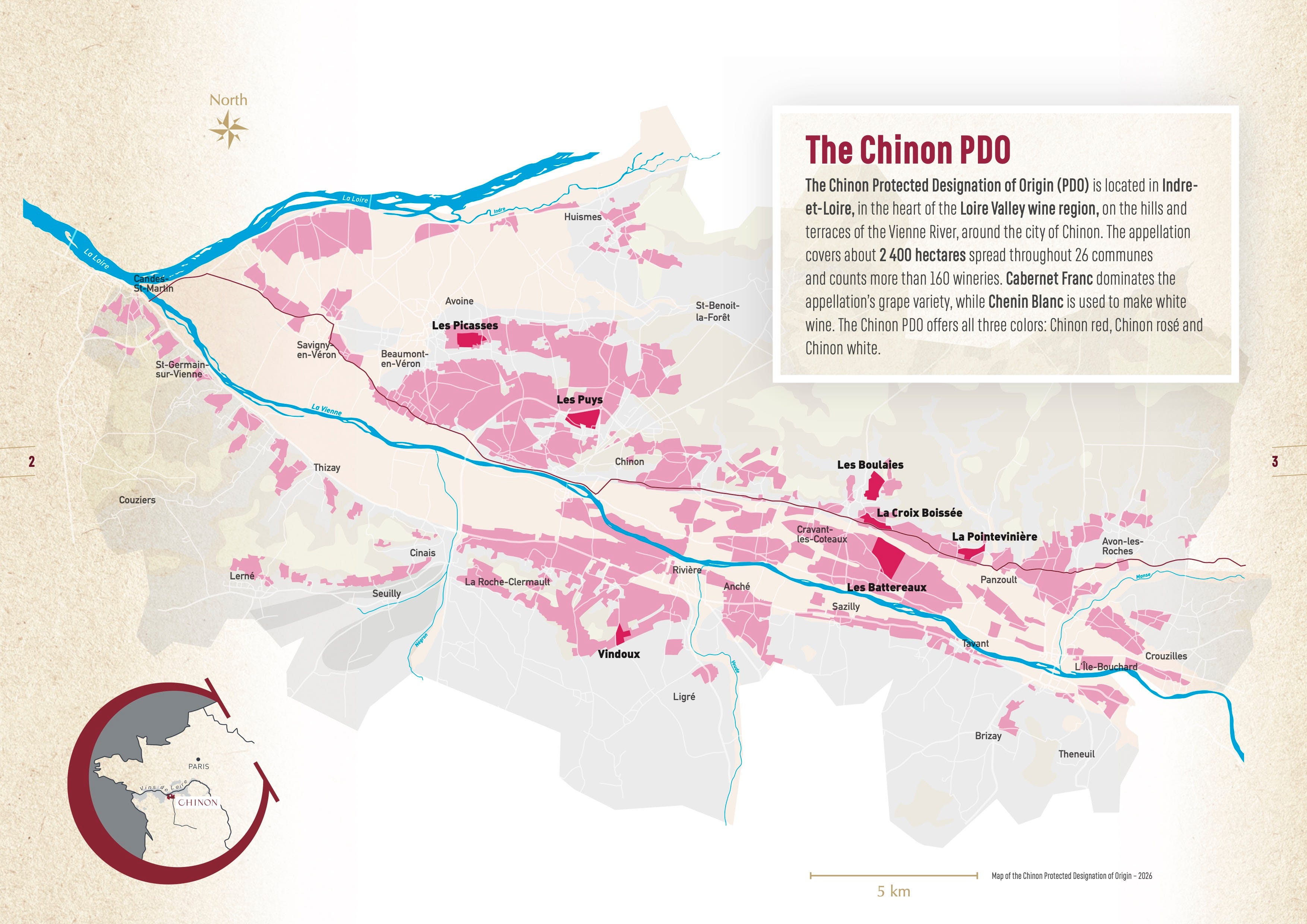
To date, seven lieux-dits have been officially recognized. La Croix Boissée, in Cravant-les-Côteaux, was the first, in 2018. La Pointevinière, in Panzoult, followed in 2023. Les Puys (Chinon), Les Picasses (Beaumont-en-Véron), and Les Boulaies (Cravant-les-Côteaux) were added in 2024, and Vindoux (Ligré) and Les Battereaux (Cravant-les-Côteaux) in 2025. Another lieu-dit is expected to be added next year, with Les Montyfauts (Ligré) and Le Pressoir (Panzoult) among the candidates, and it is expected that vignerons will continue to put forth more lieux-dits for the project as it continues to gain momentum.


Shared Vineyard, Shared Value
In an effort to collectively promote wines from Chinon, the appellation and its grower membership had long considered the idea of some sort of wine classification, whether a formal one such as Crus Classés or a more commercial one such as Vins de Garde, but a consensus was never reached. A 2014 survey found that 32% of vignerons were naming a lieu-dit on at least one cuvée in their range, which was often the top tier and most premium.
Across the roughly 2,400 hectares of vineyards, a 2008 terroir study commissioned by the Syndicat identified 51 distinct terroir units, a diversity that the parcellaire approach, and the naming of a lieu-dit on a label, allows vignerons to explore. Naming the lieu-dit adds value to the cuvée through the uniqueness of the place and lets the vigneron speak about the terroir and how it relates to what we taste in the glass. As Jean-Martin Dutour, former president of the Chinon Syndicat noted “the value of our wines is enriched by the stories they tell.”
The lieux-dits named on labels are intentional. Their names, and the vigneron’s knowledge about each site, have been passed down from generation to generation, and certain sites stand out vintage after vintage. Because land ownership in Chinon is fragmented, a given lieu-dit could be farmed by several domaines. Vignerons already shared these vineyard sites as neighbours, farming parcels side by side, so it was only logical for producers to promote these lieux-dits as a collective. “We are fortunate in Chinon,” Dutour says. “We can move from the universal to the particular: from the universality of Rabelais’s message to the history of our ancestors who shaped the landscape of the lieux-dits we know today. This long-term work allows us to better understand and highlight what we have inherited.”
A Collective Approach
Central to the project’s success is the collective approach to selecting and promoting the lieux-dits within the appellation. For a lieu-dit to be considered, it must be a delineated place on the French cadastre and be named on the labels of at least two vignerons, who must request this recognition together. The lieu-dit also must possess a certain degree of “originality” or distinctiveness within the appellation, in terms of its history and renown, the character of its landscape and terroir, how long the vignerons have used the name on labels, and its commercial potential. A working group, of which Matthieu Baudry of Domaine Bernard Baudry is a member, continues to meet to review these requests and select the sites. “What is original is that we did not require a specific cahier des charges for each lieu-dit,” Baudry says. “It simply has to meet the cahier des charges of the Chinon appellation as it currently stands.”
The vignerons proposing a lieu-dit for recognition must jointly submit a proposal detailing its significance and originality against these criteria. Once put forward, the Chinon syndicat then works alongside them to carry out a more intensive study of the lieu-dit’s history, terroir and the human factors that influence the site. The result is a monograph, an in-depth vineyard portrait, which becomes the basis for future the promotion and education of the vineyard and the Chinon appellation as a whole.


The lieux-dits project is no small undertaking. Each monograph involves extensive research by the vignerons alongside historians, toponymists, geologists and pedologists. Once complete, it is available to every vigneron to use in promoting their own cuvées, and the vineyard is marked with an engraved stone bearing the name of the lieu-dit.
Dutour is candid that this is a time-consuming, ongoing project with its pace set by the collective buy-in and effort needed at every stage. For Baudry, the point is the work itself, and that it is open to as many vignerons as possible. The approach matters, he says, “because it is collective and goes beyond the simple appreciation of the wine; it brings to light a landscape, a history and a collective.”


Naming the Place, Telling the Story
Promotion of the lieux-dits project is now beginning in earnest, with the Syndicat having waited until several vineyard monographs were complete to be able to demonstrate momentum and commitment to journalists and members of the wine trade.
For many consumers, the starting point is simply Chinon: where it is located and the basics of the region’s history, terroir and wine styles. Then the lieu-dit can be the next layer. Thomas Meunier, whose company Authentique Vin imports French wines into the southeastern United States, including those of Béatrice and Pascal Lambert, who contributed to the La Croix Boissée and Les Puys monographs, sees it working for the American consumer. “The concept of a single location is quite intuitive,” he says. “It evokes a wine from a specific place, possessing a unique character and distinct identity that sets it apart from a more generic Chinon.” Naming the lieu-dit, he adds, “provides us with more ways to tell the wine’s story, discuss its terroir, and convey what English speakers call a ‘sense of place.’ All these elements help reinforce the perception that the wine is unique, justify its premium positioning, and provide a rationale for its price point.”
For professionals, thanks to the concept of vineyard crus in regions like Burgundy and Alsace, the parcellaire approach is widely understood and appreciated. Pascaline Lepeltier, a Loire native, Master Sommelier and beverage director at Chambers in New York City, oversees a wine list known for the depth and breadth of its Loire Cabernet Franc selections. “Naming the lieu-dit allows me to locate the plot and better understand the particular expression of Cabernet Franc it can offer – whether through its geology, soil or climate,” she says.
And in the hands of a well-informed professional, the consumer can then learn to appreciate the value that the lieux-dits bring to the table. “Our clients realize that Chinon has a diversity of terroirs that can have the precision and nuance of Burgundy, for example,” Lepeltier says. “Too often, they think of Chinon as a single style. This makes it possible to explain that there is a real difference in profile, texture, food pairing potential and ageing potential, depending on origin. It sparks curiosity, gives real value, and lets us find the right bottle for our clients’ tastes and budgets with confidence. But for that, you need to know these lieux-dits!”


Terroir, Together — In Their Own Time
With the project framework in place and already twelve years of demonstrated collective work completed, the lieux-dits project is far from over. But the significance of an initiative of this magnitude is worth noting. Vignerons working together, taking ownership of their appellation and terroir, recognizing the heritage and merit of their vineyard sites, and growing the qualitative conversation around Cabernet Franc, are signalling to the wider wine world that the Chinonais believe in their land and their future. For Lepeltier, the project also says something about the grape. “Cabernet Franc is a grape variety that can truly express its origin,” she says, and the collective work “places it in the category of terroir-driven grape varieties – like Pinot Noir, Syrah, Nebbiolo or Grenache – and can bring the appellation a more highly valued (and amply deserved) reputation.”
When I launched Cab Franc Chronicles, it was a cuvée parcellaire from Chinon, Les Picasses from Olga Raffault, that inspired me to go down the rabbit hole of terroirs and expressions of Cabernet Franc. That has since become a central part of my tastings and articles over the last six years and counting. And now, Les Picasses is one of the first seven recognized lieux-dits. It is my hope that this model that the Chinon appellation and its vignerons have created starts a movement in the other Loire Cabernet Franc appellations to do similar work: to tell the story of place and grape, with depth and passion, to reach a new, curious consumer that wants to go deeper. In Chinon, the vignerons are already doing this together, one lieu-dit at a time.


This is the first in an ongoing series. Each recognized lieu-dit will have its own article, including vigneron profiles and tasting notes, for paid subscribers. If you’d like to go deeper, a paid subscription is the best way to follow along and support this work.